How Does Polymarket Work? Prices, Payouts and Orders Explained

TL;DR
- Polymarket lets you buy shares in the outcome of a real event. Each share pays $1 if that outcome happens and $0 if it doesn't.
- Prices run from 0¢ to $1, and the price works as the market's probability: 70¢ means the market thinks there's about a 70% chance.
- You trade with other people through an order book, not against the house. Polymarket earns from trading fees on most markets.
- You can sell your shares at any time before the market ends, at whatever price buyers are paying.
- On the international site, results are settled by an oracle (UMA) with a dispute process. US users trade on Polymarket US, a separate CFTC-regulated exchange that settles markets itself.
The basic idea
Polymarket is a prediction market. Instead of betting at odds set by a bookmaker, you buy shares in an outcome from other traders.
Take a market like "Will Team A win the final?". There are two sides: YES and NO.
- A YES share pays $1 if Team A wins, and nothing if they don't.
- A NO share pays $1 if Team A doesn't win, and nothing if they do.
Because one side always wins, a YES share and a NO share together are always worth $1. If YES trades at 64¢, NO is about 36¢.
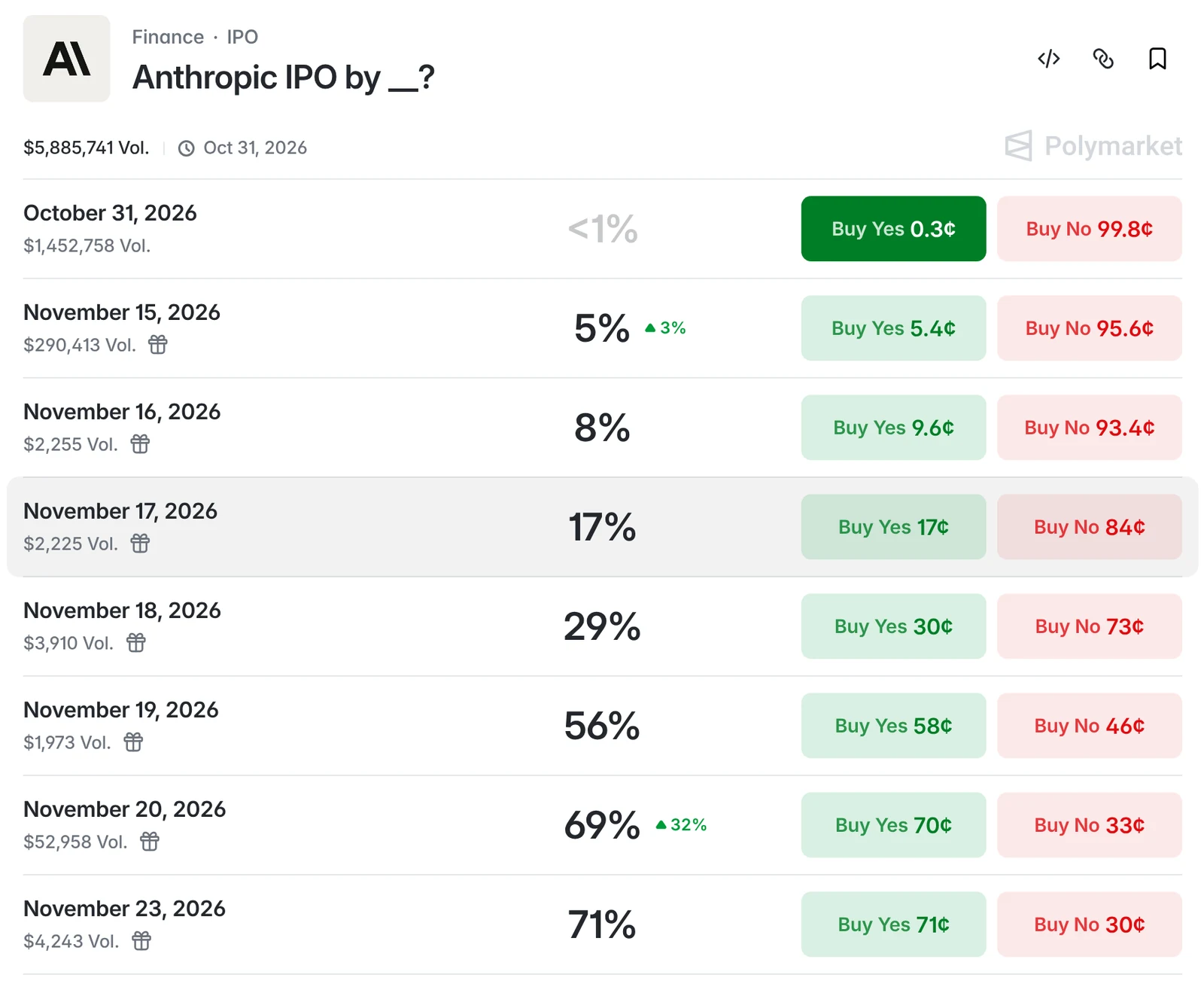
Each row is its own YES/NO market. Buy Yes and Buy No add up to about $1, give or take a cent of spread.
Why the price is a probability
If YES costs 64¢, the market as a whole is saying Team A has roughly a 64% chance. Traders who think it's higher buy YES, pushing the price up. Traders who think it's lower sell YES or buy NO, pushing it down. The price settles where buyers and sellers agree.
That's also why the price is your break-even win rate. Buy at 64¢ and you need to be right more than 64% of the time, over many bets like it, just to break even.
How a bet pays out
Say you put $100 into YES at 64¢.
- You get about 156 shares ($100 ÷ $0.64).
- If YES wins, each share pays $1: $156 back, a profit of about $56.
- If YES loses, the shares are worth $0 and you lose the $100.
On most markets a small taker fee comes off when you buy at the market price (see below), so the real numbers are slightly lower.
Market orders vs limit orders
This is the part most beginners skip, and it costs them.
Polymarket runs an order book: a list of people waiting to buy (bids) and waiting to sell (asks) at different prices.

- Market order: buy right now at the best price sellers are offering. It's instant, but if there aren't many sellers you can pay more than the price you saw, and you pay the taker fee.
- Limit order: you set the most you'll pay. It only fills at that price or better. If sellers are cheaper, you get their lower price. If the price is above your limit, your order waits and fills only if the price comes back down.
Our tips are built around limit orders. Each one has a "buy up to" price: the most you can pay and still have an edge. Set your limit there and you can never overpay.

Fees
Polymarket doesn't charge to deposit or withdraw. On most markets it charges a fee to takers, the people whose orders fill straight away against someone else's. The fee is biggest on prices near 50¢ and shrinks toward 0¢ and $1. On a mid-priced sports bet it works out at around a cent a share.
Makers, whose limit orders rest in the book until someone fills them, pay no fee and can earn rebates. We cover the details in how Polymarket makes money.
Selling before the market ends
You don't have to wait for the result. You can sell your shares to the highest bidder at any time while the market is open.
Bought YES at 64¢ and it's now trading at 80¢? You can sell and lock in about 16¢ a share. If the news turns against you, you can sell for less and cut the loss.
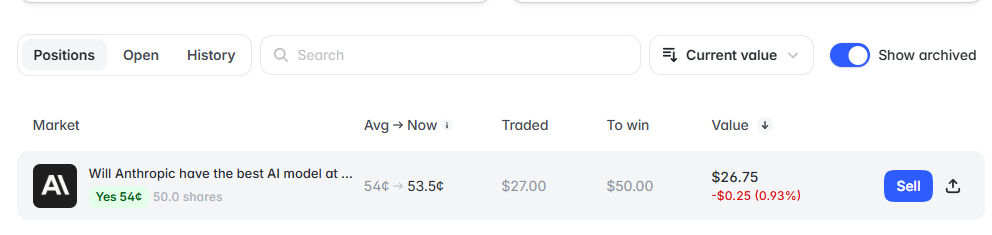
Your open bets are under Positions in your portfolio. Each one shows your average price against the current price, what you paid, what it pays if it wins and what it's worth right now. Here, 50 Yes shares bought at 54¢ are worth $26.75 at 53.5¢. Sell opens the panel to sell some or all of them at the current bids.
How markets are settled
On the international Polymarket site, markets are settled through the UMA Optimistic Oracle. Someone proposes the result and puts down a bond. If nobody challenges it within about two hours, the market resolves. If someone disputes it, there's a second round, and if that's disputed too, UMA token holders vote. Disputed markets can take several days.
On Polymarket US, the exchange settles markets itself under its CFTC-approved rulebook, with its own review process for disputed outcomes.
When a market resolves, winning shares are worth $1 and losing shares $0. In rare cases where a market can't be settled either way, it can resolve 50-50 and each share pays 50¢.

Polymarket vs Polymarket US
There are now two versions:
- Polymarket (international) at polymarket.com uses a dollar-backed stablecoin called pUSD on the Polygon blockchain. It's "close-only" in the US and the UK and several other countries, which means people there can close old positions but can't open new ones.
- Polymarket US is a separate CFTC-registered exchange, launched in December 2025, funded in dollars by bank transfer or debit card. You'll need to verify your identity, and you must be 18 or older (21 in some states). It isn't available in every state.
See our guide: is Polymarket legal in the US?
How to use Polymarket, step by step
- Sign up and verify your identity (Polymarket US) or connect a wallet or email (international, where it's allowed).
- Add funds.
- Find a market and read the rules box. It says exactly what counts as YES and which source settles it.
- Choose YES or NO, pick Limit, and set the most you'll pay.
- Enter your stake and place the order.
- Hold until the result, or sell early if the price moves.
Want to place orders with code instead? See how to get a Polymarket API key. Winnings may be taxable too: see Polymarket taxes.
Prediction Alpha Bot tips follow exactly these steps: tap the link, check the limit price, set your shares and place the order. Our step-by-step guide walks through a real tip.
FAQ
Are Polymarket odds accurate? Prices reflect what traders are willing to pay, so in busy markets they tend to be well informed. Thin markets with little money in them can be off, and can move a lot on one big order.
Who sets the prices on Polymarket? Traders do. Polymarket runs the order book but doesn't set odds or take the other side of your bet.
Can you lose more than you bet on Polymarket? No. The most you can lose on a share is what you paid for it.
How long does Polymarket take to pay out? Once a market resolves, winning shares are worth $1 straight away. Disputed markets on the international site can take several days to resolve.
Not financial advice. Prediction markets carry risk and you can lose the full amount you stake. Check that Polymarket is available where you live.