Can You Make Money on Polymarket? What Our Tests Actually Show

TL;DR
- Yes, some people make money on Polymarket, but most simple approaches lose once you count the spread and fees.
- Copying top leaderboard wallets didn't work in our test: a follower 30 seconds late turned one trader's +11.8% into −0.9%.
- Buying "near-certain" outcomes at 95–99¢ came out around −1% to −2% per bet after costs.
- What did hold up was fixed rules tested on every trade, with a hard price limit. Our four live tip strategies made +14.1% per bet in a real-price replay (Aug–Oct 2026), with 19% of bets lost.
- Win rate on its own means nothing. A bet at 80¢ needs to win more than 80% of the time just to break even.
The short answer
You can make money on Polymarket. Plenty of wallets show a profit. But the question that matters is whether you can, with the time, speed and bankroll you actually have.
We run a Polymarket tips service, so we've spent months testing ideas on real Polymarket trade data before sending a single tip. Most of the ideas people post online didn't survive that testing. Below is what we found, losses included.
How you make (or lose) money on a Polymarket bet
Every share pays $1 if it wins and $0 if it loses. The price is what you pay for that $1.
- Buy YES at 72¢ and it wins: you get $1, a profit of 28¢ per share.
- Buy YES at 72¢ and it loses: you lose your 72¢.
So the price is also the win rate you need to break even. At 72¢ you have to be right more than 72% of the time, every time, over many bets. At 90¢ you need more than 90%. That's why "I win 85% of my bets" tells you nothing on its own. If those bets cost 88¢, you're losing money.
Two costs push that break-even point higher:
- The spread. The best price to buy is usually a cent or so above the best price to sell. Buy at the market and you pay that gap.
- Fees. Polymarket charges a taker fee on some market types (it's around 1¢ a share on a mid-priced sports bet). Resting limit orders that someone else fills don't pay it.

In this esports market the cheapest seller (the ask) is at 72¢ and the best buyer (the bid) is at 71¢. Buy straight away and you pay 72¢; sell straight away and you'd get 71¢. That 1¢ gap is the spread.
What didn't make money in our tests
1. Copying the top wallets on the leaderboard
This is the most popular idea, so we tested it properly. We took 12 wallets from a 30-day Polymarket leaderboard and replayed every buy they made over 60 days, as if a follower copied each one 30 or 60 seconds later.
None of them worked as a copy target. The reasons were boring but consistent:
- Many top wallets can't be copied at all. Some are market makers that buy both sides and earn from resting orders. One bot made around 2,700 trades a day at 98–99.9¢. Four "different" wallets turned out to be one operator, hitting the same market, same side, in the same minute over 1,000 times each.
- A 30-day board rewards one hot month. One sports trader showed +21% on the board. Over July to October, a follower copying him would have made −1.7%, with three losing months before one good one.
- Big profits came from a few huge bets. The same trader's profit came mostly from three World Cup bets. A follower staking the same amount on every bet doesn't get that.
- Speed kills the edge. One politics trader made +11.8% at his own prices. A copier 3 seconds later made +1.4% before fees. At 30 seconds, −0.9%. His own buying moved the price before anyone could follow.
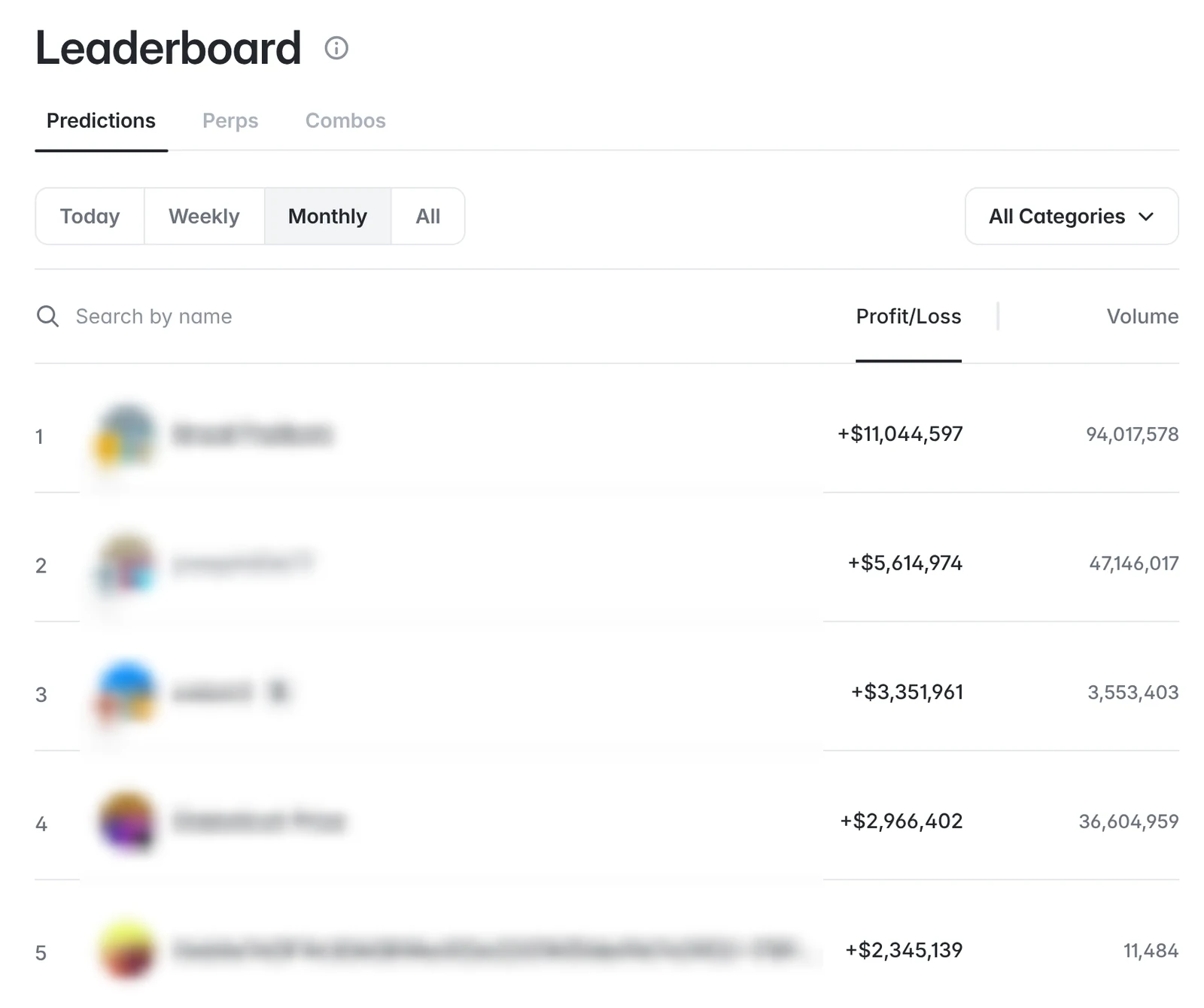
The board shows who made the most this month. It doesn't show how, or whether you could have copied it.
2. Buying "near-certain" outcomes at 95–99¢
You'll see posts calling this free money: buy the outcome that's almost certain and collect a few cents. In our data, wallets doing this came out around 0% at their own prices, and a follower paying the spread came out around −1% to −2%. One upset wipes out dozens of small wins.
3. Beating Polymarket with sportsbook odds
We compared over 1,000 European soccer matches with the Betfair Exchange, one of the sharpest betting markets there is. Polymarket tracked it closely: the average gap was about 1¢ an hour before kick-off and half a cent 15 minutes out. Buying when Polymarket looked cheaper than the line you could actually see lost money (around −7% per bet). The market had already moved.
What did make money
The approaches that held up had three things in common.
- A fixed rule, tested on every trade. Not hand-picked winners. We replay a rule on every past market it would have fired on, at the real price a follower could have got, and count every loss.
- A hard price limit. We call it "buy up to": the most you can pay and still keep the edge. If the price has already run past it, you skip the bet. In our replays, a limit order at "buy up to" beat waiting for the exact tip price, because about 30% of tips never fill at the tip price.
- Following money that tends to be right, quickly. Our strategies watch for large, lopsided buys in small markets, or several traders with long winning records landing on the same side. Then they send the tip within seconds.
Here's how our four replayed tip strategies did, bought at the real Polymarket price 10 seconds after each tip, from 1 August to 22 October 2026:
| 30-day equivalent | |
|---|---|
| Tips | 194 (about 6 a day) |
| Won / lost | 159 / 35 (82% won) |
| Return per bet | +15.3% |
| Profit at $100 a tip | +$2,973 |
The strongest group was the long tips: tips on politics and tech markets that settle 30 or more days later. They won 84–89% of the time, with about +22–24% return per bet.
That's a backtest, not a promise. Past results don't guarantee future results, real fills average about 1¢ worse than the tip price, and Polymarket's taker fee (about 1¢ a share on a mid-priced bet) comes on top if your order fills straight away. It's also why we post every result, wins and losses, in a free public channel.


Other ways people make money on Polymarket
- Market making. Placing limit orders on both sides and earning the spread plus Polymarket's maker rebates. Margins are thin (we measured one bot at roughly 0.2–0.4% of what it traded) and it takes software and capital.
- Specialist knowledge. People who follow a niche closely, like a specific esports league or a local election, sometimes spot mispriced markets before the crowd.
- Speed on live events. Some traders react to live scores faster than the market. That's a technology race, and most people won't win it by hand.
How to give yourself a real chance
- Start small: one or two strategies, not everything at once. If you follow our tips, start with the long tips (marked 🕰 LONG TIP), which were our strongest in testing and need the least watching.
- Work out your break-even win rate before every bet (it's the price).
- Use limit orders, not market orders, and set a maximum price.
- Stake the same small amount on every bet. Don't raise it to win back a loss.
- Keep a record of every bet, including the ones you'd rather forget.
- Be suspicious of any screenshot showing only wins.
- Only bet money you can afford to lose.
- Keep a record of every bet for taxes.
FAQ
Is it possible to make a living on Polymarket? A small number of traders do, mostly market makers, bots and specialists. For most people it's realistic to treat it as a side activity with a strict budget.
Do most Polymarket traders make money? Polymarket is a market between traders, so every dollar won is a dollar someone else lost, minus fees. That alone means many traders must be losing.
What's the best Polymarket strategy for beginners? Keep it simple: small fixed stakes, limit orders, a maximum price, and a written record. Stick to one or two strategies at first; with our tips, the long tips on politics and tech markets are the easiest start. If you follow tips, check that the tipster posts every result, including losses. Our guide to the best Polymarket strategies for beginners compares seven, with test results.
Does copy trading work on Polymarket? Not in our test. By the time a follower copies a trade, the price has often moved, and many top wallets earn in ways you can't copy.
Not financial advice. Prediction markets carry risk and you can lose the full amount you stake. Check that Polymarket is available where you live.